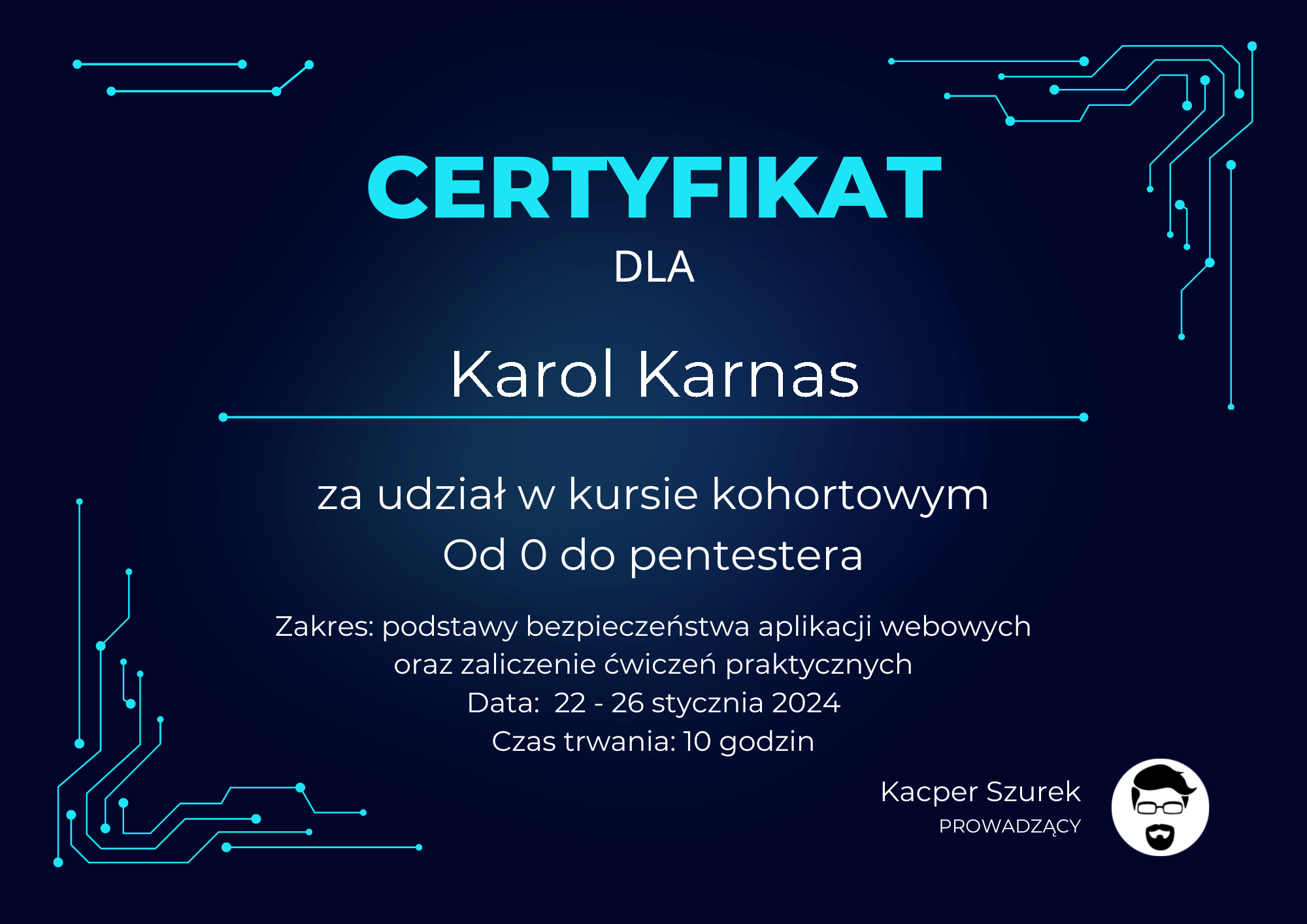
From Zero to Pentester Course
Practical web-security exercises from a developer’s perspective

Following a request beyond the happy path
I took this course to understand web vulnerabilities from the application developer’s side. The exercises connected browser behavior, requests, permissions, and server-side processing. That perspective remains useful when I build a feature across the stack and review the paths a normal walkthrough might miss.
The overview
It was a very valuable experience for me and undoubtedly for each of the participants as well. The lecturer is a great enthusiast and practitioner of cybersecurity, additionally possessing educational talents. During the training, we learned about numerous potential vulnerabilities of web applications, as well as methods of conducting attacks and the tools used for that purpose.
The exercises
The course lasted for 10 days, with nearly 3 hours each day and included 10 exercises daily. All of these exercises were from the PortSwigger page, the creators of Burp. While solving the exercises, Kacper translated all the concepts and discussed the nuances associated with them, for example what is URL encoding, basic syntax of: SQL, JavaScript, Linux commands
- Access control vulnerabilities
- Cross-site scripting (XSS)
- SQL injection
- Server-side request forgery (SSRF)
- OS command injection
- Path traversal
- Information disclosure
- Web LLM attacks
The sources
During the course, Kacper generously shared an extensive list of reliable cybersecurity knowledge sources. These resources cover a wide range of topics to enhance our understanding and skills in the field. Here are some of the recommended sources
- otwartezrodla.pl
- highon.coffee/blog/ssrf-cheat-sheet/
- owasp.org/www-project-juice-shop
- vulnhub.com
- portswigger.net/web-security/sql-injection/cheat-sheet
- docs.projectdiscovery.io/tools/nuclei/overview
Lessons for application development
The DOMPurify discussion and examples involving HTML rendering made the connection to frontend work especially clear. Other exercises reached the backend through access control, queries, and file handling. The course encouraged me to follow data through those boundaries and question what an application is trusting, instead of assuming that a working interface means the request is safe.
- npmjs.com/package/dompurify?activeTab=readme
- blog.logrocket.com/using-dangerouslysetinnerhtml-react-application/
Summary
The course gave me practical experience investigating web vulnerabilities through guided exercises. It is part of my background as an application developer, rather than a claim to work as a penetration-testing specialist. The useful habit is to consider unexpected input, permissions, and failure cases across both frontend and backend changes.